


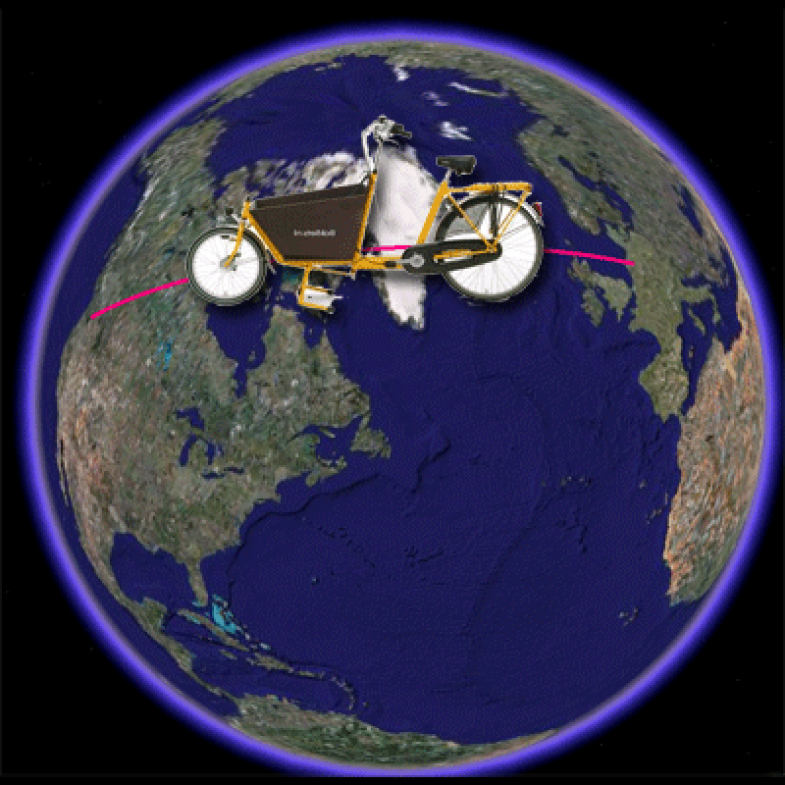
A few days ago I was thinking about how the economy seems to be shifting. I have been reading “Shock Doctrine“ by Naomi Klien and “The World Is Flat“ by Thomas Friedman, which are good companions to each other. Each describes the effects of globalization on society, one is optimistic (Friedman) the other pessimistic (Klein). My opinion falls somewhere between Klein and Friedman’s. I see the overwhelming power of the corporation as inevitable and not something that governments can hope to control (pessimist). But I also see that there are other forces that will hold corporations in check and make them more responsive to the real needs of people (optimist).

There are lots of sites that talk about Peak oil and the chaos that will result after we reach this peak. I have never been a doom-and-gloom sort of guy, but I do recognize that the supply of petroleum is limited and that eventually our dependence on it must change. The current trend towards further globalization ignores this reality. As a planet we are doing very little to prepare for this future that we all know is coming (even though there are big arguments about how quickly it will get here).
There is a meme called “relocalization“ which focuses on making communities more self-sustainable “based on the local production local production of local production of food, energy and goods“. I think this is an important effort whether you consider global warming, peak oil or just the commercialization of society to be a problem.
- Disclaimer: I am going to use bikes to illustrate my idea. I don’t think the actual example that I give is the important thing, it is just a way to get the concept across ***
Which brings me to the thought process I was having a few days ago. Our family tries to buy local when possible, and because we live in a fertile area, it is possible to buy lots of our food that way. We even manage to get some of our energy from local sources, through green power and using local biodiesel to heat our home. But when it comes to goods, the challenge is a lot bigger, even in an eco-friendly town like Portland, OR.

For example, we purchased a tandem bicycle recently from Bike Friday, in Eugene, OR. The bike is great, and was produced just 100 miles from our home. The problem is that most of the raw materials that went into the bike are not local. I don’t know where the steel for the frame, rubber for the tires, plastic for the bottle holders, etc.. all came from, but I doubt it is from within the state of Oregon. This is not news to anyone who pays attention to how things are produced in our industrialized society. But I think there is a way to get the benefits of globalization and relocalization together.
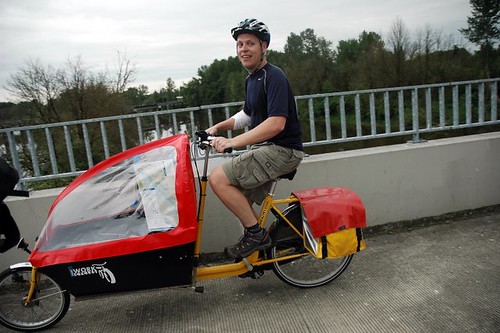
(photo credit: Jonathan Maus, BikePortland.org)
To make this point, I will give another “bikey” example. There is a maker of bikes in Holland called “Bakfiet“. They have a unique style of cargo bike that has a cargo bucket in front of the driver. It is a novel design that gives you lots of options for getting around town. The bike are expensive but well made. But, for someone living in the States, they are definitely not locally produced.
Which brings me to the relocalization part. A couple of guys here in Portland are trying to build their own version of at Bakfiet, called a “Metrofiet”. Bike Portland did an article about Metrofiet a while back.There is some controversy about the bikes because they copy the design of the Bakfiet so directly. Some people seem excited to have a local option and others are appalled at them for stealing the product design.
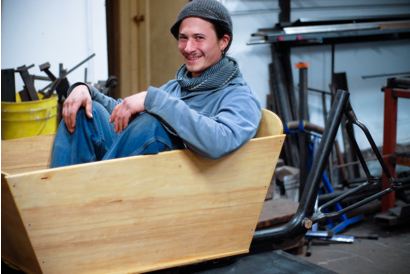
(photo credit: Jonathan Maus, BikePortland.org)
There is a fairly simple solution, which would be for Metrofiet to license the design of the bike from Bakfiet. Then they could both make money off the bike AND we could have a locally produced option. But there would still be the problem of the raw materials coming from all over the world.
This is where the intersection of globalization and relocalization comes in. To make a truly local bike, we would have to consider using other raw materials that are local. For example, we have lots of trees around here. And we even have a local manufacturer making bikes out of wood (Bike Portland has a great article on the company). Are there alternative materials for other parts of the bike as well? I have no idea, but I certainly think it is possible. That’s the relocalization part. The globalization part is the knowledge required to accomplish this relocalization.
If we can combine our knowledge of local raw materials with local manufacturing and global design, then we can have local goods that use the best possible designs. I realize this is not a simple problem because you can’t divorce design from raw materials. But allowing creating a global market for design means you take advantage of the intelligence of the world while not requiring massive energy consumption.
The title mentions a business opportunity. The way I see it there is a huge opportunity for companies that can manufacture things locally, using local resources. Manufacturing companies that have a deep knowledge of the local raw materials as well as a way to outsource designs for products will have a bright future. If you combine that sort of capability with the globalized design (meaning designs that are created, and licensed, from all over the world), then you are taking the best of both worlds. Imagine a database where you could look up designs for “human powered transport” based on the raw materials and manufacturing processes you have locally. Oregon might have a lot of raw materials common to other places with similar climates, and therefore could use and share designs with those areas. But the manufacturing and raw materials would all be local.
Manufacturers could become much more general, while designs become much more specific. Instead of shipping raw materials all over the place and then shipping finished goods around as well, only the IDEAS and DESIGNS would move around.
Is this sort of thing possible today? Probably not. But I see a big future for the companies that can make it happen, both on the manufacturing and design side.